
Savings rates
Rates reviewed daily · last updated 5 October 2026
Savings rates
All rates AER · Updated October 2026
Rates shown are AER and correct as of October 2026.
Regular Saver
| Account | AER | Monthly Limit | Interest | Min Balance | |
|---|---|---|---|---|---|
| Monthly Saver | 5.00% | £250 | Fixed | £25 |
Cash ISA
| Account | AER | Access | Transfers in | Min Balance | |
|---|---|---|---|---|---|
| Fixed Cash ISA 2 Year | 4.10% | 2 Years | Accepted | £500 | |
| Fixed Cash ISA 1 Year | 4.00% | 1 Year | Accepted | £500 | |
| Advantage ISA Saver | 3.00% | 3 withdrawals | Accepted | £1 | |
| Access Cash ISA | 0.75% | Instant | Accepted | £1 | |
| ISA Saver | 0.75% | Instant | Accepted | £1 |
Fixed Rate
| Account | AER | Term | Interest paid | Min Balance | |
|---|---|---|---|---|---|
| Fixed Rate Bond 2 Year | 4.10% | 2 Years | Monthly/Annually | £500 | |
| Fixed Rate Bond 1 Year | 4.00% | 1 Year | Monthly/Annually | £500 |
Easy Access
| Account | AER | Access | Interest | Min Balance | |
|---|---|---|---|---|---|
| Advantage Saver | 3.00% | Instant | Variable | £1 | |
| Access Saver | 0.75% | Instant | Variable | £1 | |
| Instant Access Savings Account | 0.75% | Instant | Variable | £1 |
Junior ISA
| Account | AER | Access | Interest paid | Min Balance | |
|---|---|---|---|---|---|
| Junior Cash ISA | 2.35% | Locked until 18 | Annually | £1 |
Investing: Stocks & Shares ISA
A Stocks & Shares ISA is an investment product, so returns depend on the market rather than a fixed savings rate. Here's how it compares on cost.
When you invest, your capital is at risk — the value of investments can go down as well as up, and you may get back less than you put in.
Cards
The Bank of Scotland card we track — open it for fees, perks and the catch.
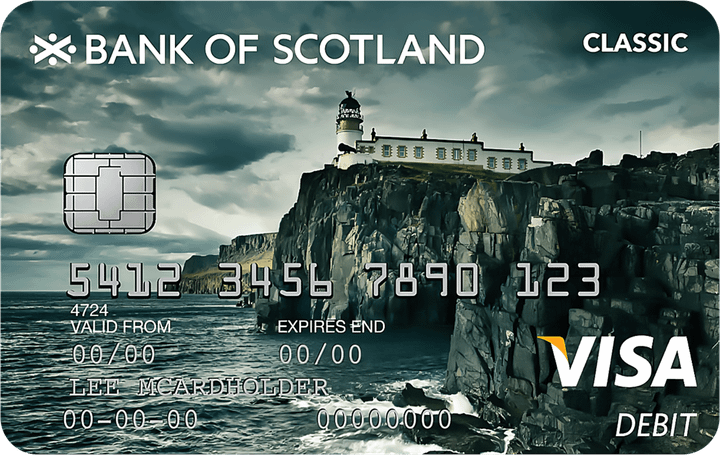
Classic
Free
Up to 15% cashback with selected retailers
- Abroad
- 2.99%
- £30 per £1,000
Is Bank of Scotland FSCS protected?
Yes — FSCS protected up to £120,000
Yes. Bank of Scotland savings are FSCS protected up to £120,000 per person, per banking licence, under Bank of Scotland plc. The same limit is shared with Halifax and Birmingham Midshires.
Banking licence: Bank of Scotland plc
Shares this limit with Halifax, Birmingham Midshires.
Last checked against the FCA register on 5 October 2026.
See every brand that shares a banking licenceSwitch offers
Who they are
Bank of Scotland was established by the Parliament of Scotland in 1695, making it the oldest bank in Scotland and the longest continuous issuer of banknotes in the world. That is over 330 years of history - a heritage few banks anywhere can match. In 2001, Bank of Scotland merged with Halifax to form HBOS plc, before HBOS was acquired by Lloyds TSB in 2009 to form Lloyds Banking Group. Today the bank operates primarily in Scotland, sitting alongside Halifax and Lloyds Bank under the same group umbrella.
One thing worth flagging before you save: Halifax and Bank of Scotland share one FSCS £120,000 limit, operating under the Bank of Scotland plc banking licence, along with Birmingham Midshires.
Lloyds Bank has a separate licence. So if you already save with Halifax, your combined balance across both brands counts against a single cap.
Savings accounts
Bank of Scotland offers a reasonable spread of accounts, from easy access through to fixed-rate bonds and ISAs. The headline rate right now belongs to the Monthly Saver at 5.00% fixed - though you will need a Bank of Scotland current account to open one, and there is a minimum monthly deposit of £25. It is a good home for money you can drip in each month, but remember the rate applies only to the balance as it builds, not to a lump sum sitting there from day one.
For those who want to lock money away, the Fixed Rate Bond and Fixed Cash ISA both follow the same structure: a 1-year option at 4.00% and a 2-year option at 4.10%, each requiring a minimum of £500. The fixed ISA wrapper is worth thinking about if you have used or are close to using your Personal Savings Allowance.
The Advantage Saver pays 3.00% variable on easy access with just £1 to open, while the Access Saver and a handful of other accounts sit at a much lower 0.75% variable - worth knowing if you are considering leaving money in the default account after a fixed term ends.
For families, there is a Junior Cash ISA at 2.35% variable and two children's savings accounts at 2.25% variable. These are straightforward options but the rates sit below the best Junior ISA deals on the market, so it is worth comparing before opening one for a child.
Is it right for you?
Bank of Scotland suits savers who already bank there and want to keep things in one place - particularly anyone who can unlock the Monthly Saver by holding a current account. Bank of Scotland's eligible deposits are protected by the FSCS up to £120,000 per person, per authorised firm (banking licence). Just be mindful of the shared licence with Halifax if you hold savings at both.
There is no switch offer in place at the moment. If switching current accounts is part of your thinking, it is worth checking what other providers currently have on the table.
Rates change, sometimes quickly. The live figures shown on this page are always the most up-to-date - check them before you apply.
This overview was generated by DepositScout's AI, Penny on 1 October 2026. It may contain inaccuracies — always confirm rates and terms with Bank of Scotland directly. Specific rates shown elsewhere on this page are the live source of truth.


